




One of the most common things I hear from GMs and commercial leaders is this:
“Marketing feels expensive.”
- Budgets increase
- Activity multiplies
- Visibility is high
Yet commercial impact feels inconsistent, difficult to explain, and hard to attribute.
Over time, marketing begins to be viewed as a cost centre rather than a commercial driver.
This is not because marketing lacks value.
It’s because marketing is rarely positioned correctly within the commercial system of the hotel.
The misconception that creates the problem
When marketing is treated as a standalone function, it becomes easy to judge it in isolation.
- Campaigns are evaluated separately from pricing decisions
- Content is produced separately from sales priorities
- Visibility is measured separately from demand quality
In that structure, marketing will always feel expensive.
Not because it isn’t working.
But because it isn’t aligned.
What I consistently see across hotels
Across luxury resorts, boutique hotels, and complex operating environments, a clear pattern repeats.
Marketing, sales, and revenue are all working hard.
But they are not working together.
Each function optimises for its own objectives:
- Revenue focuses on yield and short-term performance
- Sales focuses on conversion and pipeline
- Marketing focuses on visibility, content, and campaigns
All logical. All necessary.
But without a shared commercial direction, effort fragments.
Teams pull in parallel, sometimes even in opposite directions.
Momentum slows, not through lack of capability, but through lack of alignment.
This is the moment marketing stops driving revenue, quietly, gradually, and without a clear failure point.
I’ve discussed this matter on a recent LinkedIn post and here you can see what other industry leaders are observing.
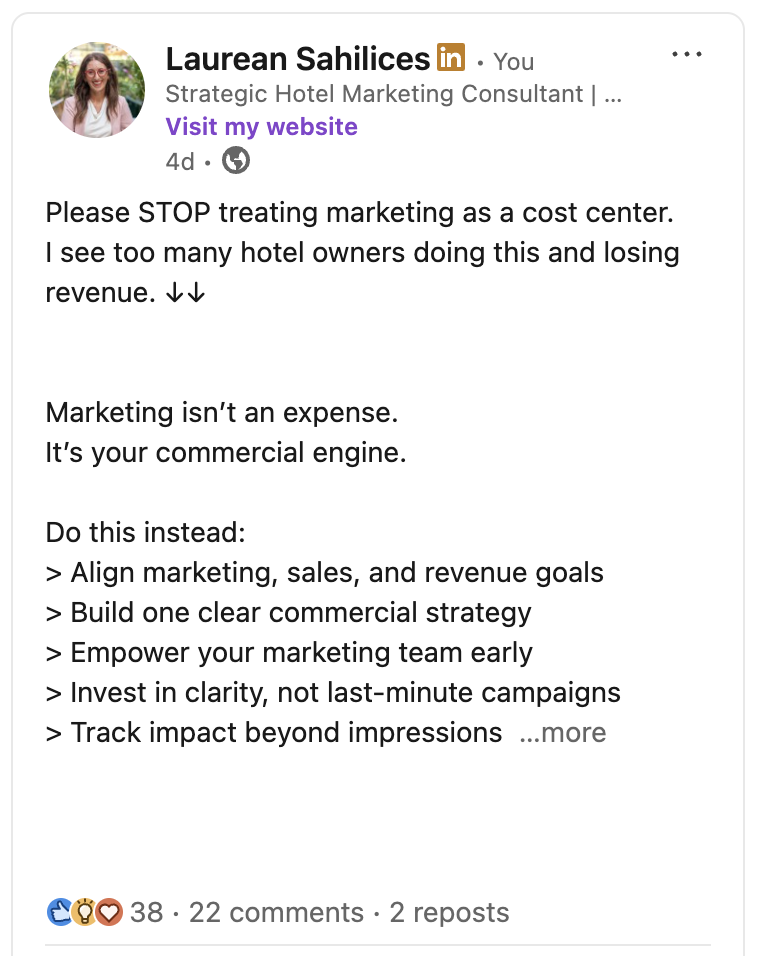
You can join the conversation here
Why this disconnect affects the guest experience
This misalignment doesn’t only impact numbers.
It impacts how the hotel is experienced.
Operational leaders are expected to deliver a consistent guest experience.
Frontline teams are trained on standards, service, and brand values.
But when marketing, sales, and revenue are not aligned at leadership level, the message reaching the guest becomes inconsistent.
Expectations are set in one direction.
Delivery happens in another.
The hotel feels fragmented rather than cohesive.
Alignment is not just a commercial issue.
It’s an experience issue.
Alignment is not a tactic. It’s a leadership system
High-performing hotels do not rely on more activity to solve commercial challenges.
They rely on clarity.
They define:
- who the hotel is for
- what commercial priorities matter most right now
- what marketing should support and what it should not
Marketing then becomes a system that reinforces those decisions, not a function reacting to pressure.
This is where marketing shifts from cost centre to commercial engine.
The system that changes outcomes
The difference between hotels where marketing performs and hotels where it feels expensive is not effort.
It is structure.
When marketing, sales, and revenue are aligned around:
- shared commercial goals
- clear decision frameworks
- and leadership direction
Execution compounds.
Teams stop guessing.
Decisions simplify.
Resources are used with intent.
This is not about doing more.
It’s about doing the right things in the right order.
The question worth asking
If marketing currently feels like a cost centre in your hotel, the question is not:
“How do we reduce spend?”
It’s this:
“Are marketing, sales, and revenue aligned around the same commercial direction?”
The answer usually reveals where performance is quietly being limited.
A next step for leaders
If you’re unsure whether your current marketing approach is structured to support commercial outcomes or whether misalignment is diluting impact, this strategic self-assessment will pre-inform where clarity is missing and where opportunities exist.
I work with GMs and commercial leaders to assess their current marketing structure, identify points of misalignment, and create a clear framework that allows teams to execute with confidence.
If this perspective resonates, you can book a strategic clarity call to review your current approach and identify opportunities for alignment.

